

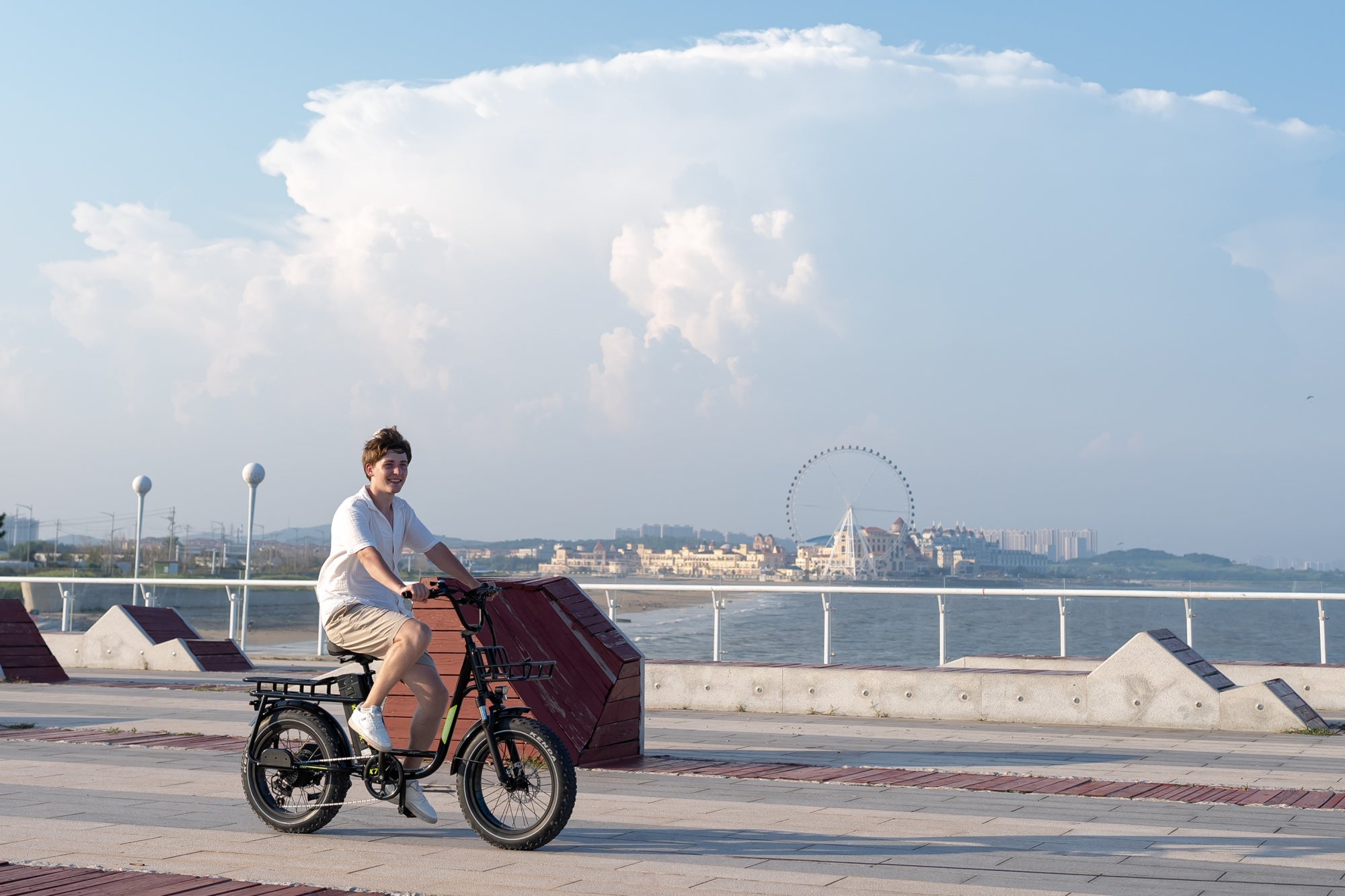
One of the most common questions for anyone considering a shift toward a car-light lifestyle is: how far does electric cargo bike travel? This question is at the heart of "range anxiety"—the fear that your battery will run out of power halfway through a grocery run or while you have two tired children sitting in the back.
Understanding the range of an electric cargo bike is different from understanding a standard e-bike or an electric car. Because cargo bikes are designed to carry significant weight, their energy consumption is much more variable. A bike that travels 50 miles while empty might only travel 25 miles when loaded with 150 pounds of cargo.
In this guide, we will break down the science of e-cargo bike range. we will explore the technical specifications of batteries, the real-world factors that drain your power, and the practical steps you can take to ensure you always have enough "juice" to get home.
The Technical Foundation: Watt-Hours Explained
To answer "how far does electric cargo bike travel," we first have to look at the battery's capacity. In the world of electric vehicles, capacity is measured in Watt-hours (Wh).
You can think of Watt-hours as the size of your fuel tank. A larger Wh number means a larger tank. Most entry-level cargo bikes come with a battery between 400Wh and 500Wh. Premium models often feature 600Wh to 750Wh batteries, and some professional-grade bikes offer dual-battery systems totaling 1,000Wh or more.
On a flat road with a moderate load and average pedal assist, a typical e-cargo bike uses about 20 to 25 Watt-hours per mile. If you have a 500Wh battery, a simple calculation (500 divided by 25) suggests a range of about 20 miles. However, as we will see, this number can fluctuate wildly based on how you ride.
The Weight Factor: Why "Cargo" Changes Everything
The defining characteristic of a cargo bike is its ability to haul weight. However, weight is the enemy of battery range.
Every extra pound you add to the bike requires more torque from the motor to reach and maintain speed. If you are riding a "longtail" bike with two children and a week’s worth of groceries, your total vehicle weight could easily exceed 400 pounds.
In this scenario, the motor is under constant heavy load. This can increase your energy consumption to 30 or even 40 Watt-hours per mile. This is why a bike that feels like it has "infinite range" when you ride it alone can suddenly seem thirsty for power when the whole family is on board.
The Impact of Terrain and Elevation
If you live in a flat city like Amsterdam or Chicago, your range will be very predictable. If you live in a hilly city like San Francisco or Sheffield, your range will be significantly lower.
Gravity is the most significant drain on an e-bike battery. When the motor helps you climb a steep hill, it draws a massive amount of current from the battery. While you might recover a tiny bit of energy if the bike has regenerative braking (which is rare on e-bikes), most of that energy is simply spent fighting gravity.
A single mile of steep climbing can drain as much battery as five miles of flat riding. If your daily route involves significant elevation gain, you must factor this into your range expectations and consider a bike with a higher-capacity battery.
Pedal Assist Levels: Choosing Speed vs. Distance
Most electric cargo bikes offer three to five levels of assistance, usually labeled as Eco, Tour, Sport, and Turbo (or similar). How far your bike travels is directly tied to which button you press on your controller.
Eco Mode: This provides the least amount of help. You have to do most of the work, and the motor just offsets the weight of the bike. In Eco mode, you might achieve 50 to 60 miles on a single charge.
Turbo Mode: This is the "fun" mode. It makes the bike feel powerful and fast, even on hills. However, Turbo mode can drain a battery in as little as 15 or 18 miles if used constantly under load.
The secret to maximizing range is to stay in a lower assist mode on the flats and only "shift up" to Turbo when you are facing a steep incline or a strong headwind.
Stop-and-Go Traffic and Urban Riding
Interestingly, the environment you ride in also dictates how far your electric cargo bike travels.
In a car, city driving is less efficient because of constant idling and braking. On an e-cargo bike, the biggest energy draw occurs when the bike is accelerating from a dead stop. If you are riding in a city with a stop sign or red light on every block, your range will be lower than if you were riding on a long, continuous bike path.
To save battery in the city, try to anticipate lights. If you see a red light ahead, stop pedaling and coast to a stop rather than using the motor until the last second and then slamming on the brakes.
Weather, Wind, and Aerodynamics
Because cargo bikes are large, they are not particularly aerodynamic. Front-loaders (Bakfiets) have a large "box" in the front that acts like a sail.
If you are riding into a 15 mph headwind, your motor has to work significantly harder to maintain your cruising speed. Wind can reduce your range by as much as 20% to 30% on an open road.
Temperature also plays a role. Lithium-ion batteries rely on chemical reactions that slow down in the cold. If you are riding in sub-freezing temperatures, you may notice that your battery percentage drops faster than it does in the summer. It is always a good idea to store your battery indoors during the winter to keep it at an optimal temperature.
Mechanical Efficiency: The Role of Gears and Tires
Many people forget that an e-cargo bike is still a bicycle. Its mechanical efficiency directly affects its electrical efficiency.
If your tires are under-inflated, the rolling resistance increases. This forces the motor to work harder just to keep the wheels turning. Simply keeping your tires at the correct PSI can add two or three miles to your total range.
Similarly, using your gears correctly is vital. If you try to start from a standstill in a "hard" gear, the motor has to use a massive burst of energy to get you moving. If you shift into a "low" gear as you come to a stop, you can use your own leg power to get the bike rolling, which saves the battery for the long haul.
The Dual-Battery Solution
For those who have long commutes or work in delivery services, a single battery might not be enough. This is why many top-tier cargo bike manufacturers (like Riese & Müller, Tern, or Rad Power) offer dual-battery configurations.
By mounting two batteries on the frame, you effectively double your "fuel tank." A dual-battery setup can provide a realistic range of 60 to 100 miles, even with a heavy load. This is usually enough for an entire day of errands or a full shift of professional delivery work without needing to stop and recharge.
Managing Range Anxiety: Tips for the Road
So, how do you make sure you don't run out of power?
First, get to know your bike. For the first few weeks, keep track of how many miles you ride and how much battery is left. Most modern e-bike displays provide a "Range" estimate that updates in real-time based on your assist level.
Second, always carry your charger if you are planning a ride that is near the limit of your battery’s capacity. Most e-cargo bike batteries can be charged to 80% in just a couple of hours. A quick "top-off" while you are having lunch can give you the extra few miles you need to get home comfortably.
The Final Verdict
How far does an electric cargo bike travel? While the marketing materials might claim 50 or 70 miles, a realistic "everyday" range for a single-battery cargo bike is usually between 25 and 40 miles.
If you are carrying heavy loads or climbing big hills, expect it to be on the lower end of that scale. If you are riding empty and using Eco mode, you can push it to the higher end.
The beauty of the e-cargo bike is that even 25 miles is usually more than enough for 95% of urban trips. Once you understand how weight, terrain, and your own riding style affect the battery, you can stop worrying about the numbers and start enjoying the ride.
Share:
How Far Can Electric Cargo Bike Travel? The Complete Guide to Range and Battery Life
How Many Miles Can Electric Cargo Bike Travel? The Real-World Range Guide